.png)
-min.jpg)

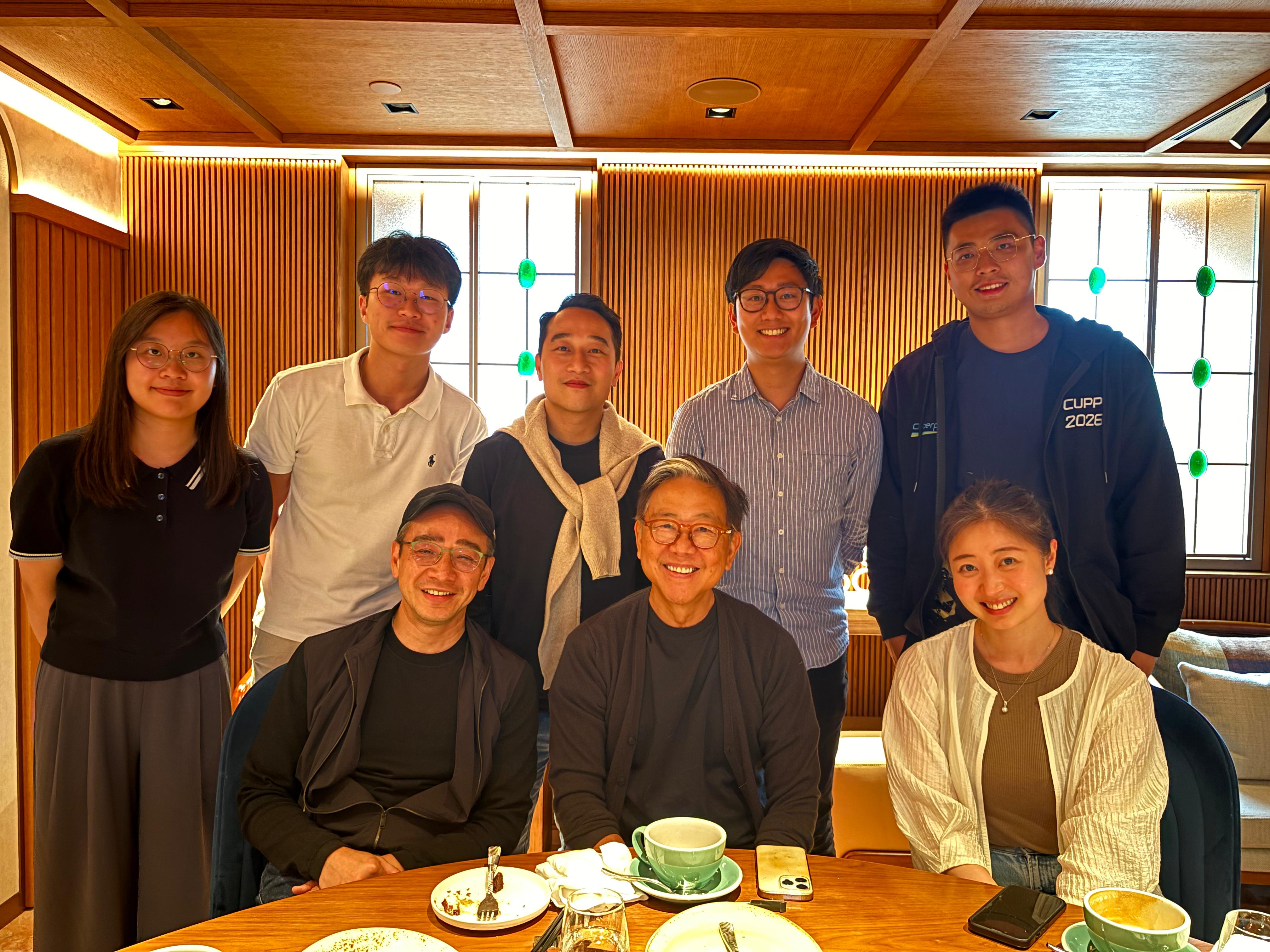
The Project Melo lunch with William Lim, founder of CL3 and one of Hong Kong's most celebrated architects, was a rare opportunity to sit across from someone who has spent decades reshaping how people live, work, and experience cities. Joining Kenny, Tommy, and Ellen, we spent the afternoon in wide-ranging conversation with William, moving freely between architecture, creativity, and the future of talent.
The insight I personally found most memorable came from a question about how architects pitch a vision that is still half-formed. His answer was simple but resonant: before you can convince anyone else, you must convince yourself. He compared it to selling a painting. If you privately think the work is mediocre, anyone looking at it will feel that too. Belief in the idea has to come first, and it has to be genuine. As for clients who still won't listen? William was refreshingly unbothered. That, he said, is their own mistake. There is a quiet confidence in internalizing that fully.
The conversation then turned to what makes someone truly excellent in a creative field. William observed that focusing on one thing alone is no longer enough — a well-rounded life, diverse experiences, and genuine curiosity matter as much as technical training. He reflected on the contrast between Hong Kong's education system, which trains you to remember, and his time studying in the United States, where the emphasis was on knowing how to find things out. In a world saturated with information, the ability to seek, feel, and form your own judgment is far more valuable than memorization.
On AI, William was positive and forward-looking. He does not see it as a threat to design, but as another phase in a long history of transformative tools. Photography, electricity, the motor car, AI follows the same arc. When cars replaced horses, he pointed out, it did not mean all the horses had to be killed. You simply evolve into something else. The same logic applies to architecture. AI is already changing how his practice works, and his view is that the right question is not how to resist it, but how to embrace it. His response when asked whether AI could replicate his design was insightful: by the time it learns what I did, I have already moved on. The implication being that staying ahead is not about fighting the tool, but about continuing to grow faster than it can catch up. If we never stopped evolving and developing, what gets replicated is always already behind where we are.
It is not every day you get to share a lunch table with one of the city's iconic figures in architecture and art, and I am grateful to Kenny and Project Melo for making it possible. More than any single insight about design, what William left us with was a mindset: build your own taste, trust your own judgment, and never stop asking why not.
— from Hynton Tang, private lunch with William Lim.